By observing the movements of the Sun, Moon, planets, and stars, astrologers developed ways to map important positions in the sky and interpret their meanings. The moment we are born brings many of these positions together, creating what astrology uses to explore personality, emotions, potential, challenges, relationships, and direction in life.
That map is what we call a birth chart. So, what exactly is it?
This article may feel a little more technical than my previous ones — almost like a beginner's lesson. If you're completely new to the subject, I recommend first reading What Is a Zodiac Sign? Meaning, Personality, and the 12 Signs Explained and Sun, Moon, and Rising Signs: What Do Your Big Three Mean?. They will give you some of the basic ideas you need before going further.
It took me several attempts before I began to understand some of the rules behind reading a birth chart. There are quite a few pieces to put together, so it can look confusing at first. But don't let that discourage you. Once you understand how those pieces connect, reading the chart becomes much more interesting.
What Is a Birth Chart?
A birth chart, also called a natal chart, is a map of the sky showing the positions of the Sun, Moon, planets, and important astrological points at the time and geographical location of your birth.
Most birth charts are displayed as a circular wheel divided into different sections. When you first see one, you may notice zodiac symbols around the outside, planetary symbols placed throughout the chart, numbers representing different houses, and lines crossing through the center.
To create your own birth chart, you normally need three basic pieces of information:
• Your birth date
• Your exact birth time
• Your birthplace
Your birth time is especially important because it helps determine your Ascendant, or Rising sign, as well as the structure of the houses in your chart.
Once you have a chart in front of you, the next question is where to begin.
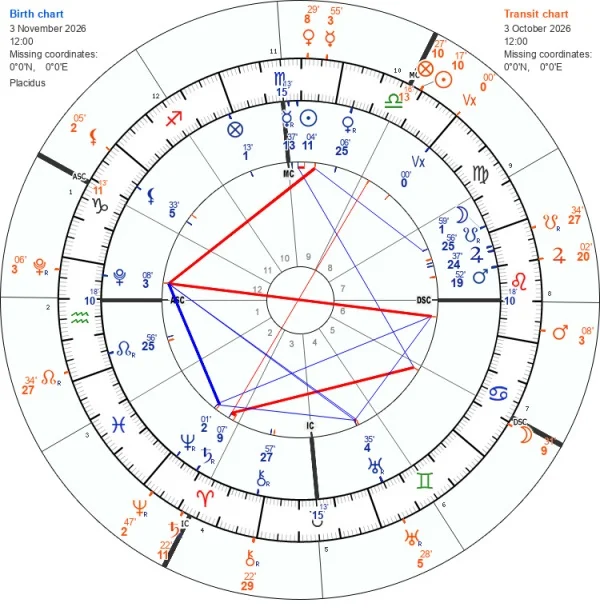
The Four Main Parts of a Birth Chart
When I first looked at a birth chart, I found it easier to stop thinking about the whole circle and separate it into a few basic parts.
For a beginner, there are four main things to recognize: the 12 zodiac signs, the planets and important points, the 12 houses, and the aspects.
The 12 Zodiac Signs
These are the same 12 signs you are probably already familiar with: Aries, Taurus, Gemini, Cancer, Leo, Virgo, Libra, Scorpio, Sagittarius, Capricorn, Aquarius, and Pisces.
But your birth chart doesn't contain only one zodiac sign.
You may have your Sun in Leo, your Moon in Cancer, Mercury in Virgo, Venus in Libra, and so on. Each planet can occupy a different zodiac sign at the time of your birth.
This is also why two people with the same Sun sign may have very different personalities. I once had a conversation with a coworker about this, which inspired me to write Why Do People With the Same Zodiac Sign Have Different Personalities?.
The Planets
In astrology, each planet is associated with a different part of life or personality.
The Sun is connected with core identity and direction, while the Moon is associated with emotions and instincts. Mercury relates to thinking and communication, Venus to love, attraction, relationships, and values, and Mars to action, drive, and desire.
There are more planets to explore later, but these are already enough to give a beginner plenty to work with.
The 12 Houses
A birth chart is also divided into 12 houses.
While zodiac signs help describe how a planetary theme may be expressed, houses are associated with different areas of life.
For example, the 1st House is connected with self and identity, the 4th House with home and family, the 7th House with partnerships, and the 10th House with career, reputation, and public life.
Aspects
The lines you see crossing through the middle of many birth charts represent aspects — angular relationships between planets.
You may eventually come across names such as conjunction, opposition, trine, square, and sextile.
I wouldn't worry too much about aspects when reading your first chart. I think there is already enough to understand before reaching that point.
How to Read a Birth Chart in 5 Steps
Once you know what the main pieces are, you can begin reading the chart.
I found it much easier to follow an order instead of jumping from one symbol to another. If you're a beginner, these five steps give you a simple place to start.
Step 1: Create Your Birth Chart
First, create your personal birth chart using your:
Birth date + exact birth time + birthplace
A birth chart calculator uses this information to calculate the positions of the Sun, Moon, planets, Ascendant, houses, and other astrological points for the moment you were born.
Try to use the most accurate birth time you can find. Even if your Sun sign remains the same, the Rising sign and house placements depend much more closely on birth time and location.
When your chart appears, don't try to read everything immediately.
Start with the parts you already know.
Step 2: Find Your Big Three
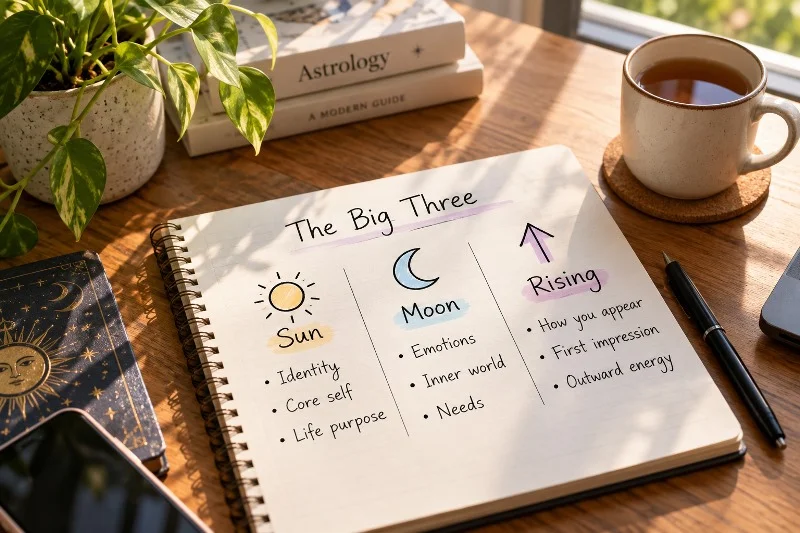
The first three placements I would look for are your Sun, Moon, and Rising signs, often called the Big Three.
Since I covered these in my previous article, I won't go deeply into them again here.
In simple terms:
Sun Sign — core identity, motivation, and life direction
Moon Sign — emotions, instincts, and emotional needs
Rising Sign — how you approach the world, new situations, and the impression you may give
For example, your chart might show:
Sun — Leo
Moon — Cancer
Rising — Libra
Write down your own three placements. At this stage, you already have a much better starting point than simply looking at the entire chart at once.
Step 3: Find Mercury, Venus, and Mars
After the Big Three, I would move to Mercury, Venus, and Mars.
These three are useful for beginners because they introduce a simple idea that appears throughout birth chart reading: a planet has its own meaning, but the zodiac sign it occupies adds another layer.
For example:
Mercury is associated with thinking and communication.
Venus is associated with love, attraction, relationships, and personal values.
Mars is associated with action, drive, desire, and how we pursue what we want.
Now look at which zodiac sign each of these planets occupies in your chart.
You might find:
Mercury in Gemini
Venus in Aries
Mars in Capricorn
This gives you a simple way to begin:
Planet + Sign
The planet tells you what kind of theme you are looking at, while the sign helps describe how that theme may be expressed.
You don't need to memorize every possible combination. I found it much easier to begin with the placements in my own chart and learn from there.
Step 4: Look at the Houses
Once you are comfortable finding planets and signs, look at the houses they occupy.
This adds another piece to the picture.
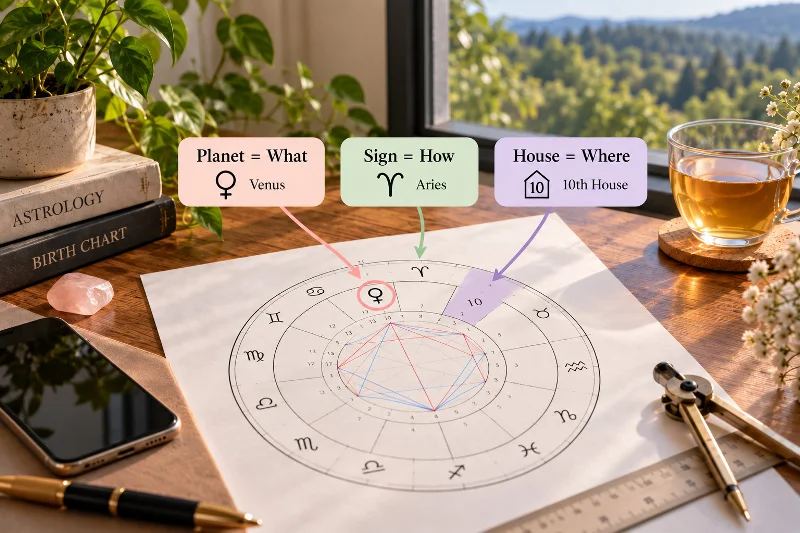
For example, imagine that you find Venus in Aries. You now know the planet and its zodiac sign, but the chart may also show that Venus is located in the 10th House.
Now you have:
Planet + Sign + House
A simple way to remember the basic idea is:
Planet = What
Sign = How
House = Where
This isn't a complete interpretation of a birth chart, but I think it is a useful way for beginners to understand how the pieces begin to connect.
The houses help show the areas of life where those planetary themes may be expressed.
You don't need to memorize all 12 houses immediately. Start by identifying where a few important planets fall and then learn the meaning of those houses.
Step 5: Put the Pieces Together
This is where reading a birth chart starts to become more interesting.
Let's use the example:
Venus in Aries in the 10th House
Instead of trying to interpret the whole placement immediately, break it into three pieces.
Venus is associated with love, attraction, relationships, and values.
Aries is traditionally associated with initiative, independence, directness, and action.
The 10th House is associated with career, ambition, reputation, and public life.
When these pieces are combined, an astrologer might explore how a more direct or independent Venus style appears in areas connected with career, ambition, or public identity. Relationships and personal values may also interact with professional goals in interesting ways.
The important thing here is not to treat one placement as a complete description of a person.
Your chart contains many placements, and they interact with one another.
For a beginner, I would simply practice this basic pattern:
Planet → Sign → House
Once you become comfortable with that, you can begin looking at aspects and the relationships between different planets in your chart.
Don't Try to Read Everything at Once
One thing I learned from trying to understand my own birth chart is that memorizing definitions is not enough.
You can read what Venus means, what Aries means, and what the 10th House means, but you still need some practice before combining them begins to feel natural.
That's why I think working with an actual birth chart is useful.
Start with your own chart. Find your Big Three. Then find Mercury, Venus, and Mars. Look at their signs and houses. Read about those placements individually and compare them with what you already know about yourself.
After doing this several times, the chart begins to look less like a collection of strange symbols.
Then, when you're ready, you can move further into the houses, aspects, and other planets.
You don't have to understand the entire sky in one afternoon.
Final Thoughts
If you've made it this far, you may still feel a little confused. A birth chart doesn't really come in separate beginner, intermediate, and advanced stages. Everything appears together from the beginning, which can make it difficult for anyone who is just starting out. I felt the same way and had to practice many times before I began to understand how the different parts work together and how astrology interprets the reflection of the planets, stars, and universe in each of us.
I think the curiosity you and I share is quite simple: we want to understand how the moment of our birth might be reflected in this universe.
But a birth chart is not a fixed destiny, nor does it mean that our future has to unfold in a certain way. For me, it is simply another way to understand ourselves spiritually and feel a little more connected with nature and the universe around us.
Our life and our future are still shaped by the choices we make, guided by our own will and feelings.