I still remember when I was in middle school and my mother told us we were moving into a new home—a house my parents had worked very hard to buy.
For us kids, the news was simple: we were getting a new house.
We were excited. I thought about my new room, where we would put our things, and what it would feel like to sleep there for the first time.
My mother was thinking about completely different things.
Besides packing, she was deciding what shouldn't come with us, which day we should move, what time we should arrive, and even which door we should use when entering the house for the first time.
I didn't understand any of it.
Why couldn't we just pack everything, hire a truck, and move?
That question stayed with me. Much later, I began looking into some of the things my mother had done and realized that many were connected to folk traditions passed down through families.
These customs aren't the same everywhere. Some have roots in Asian traditions, while others can be found in European and American folklore. Families may also have their own versions.
What they often share is a simple idea: when people move into a new home, they want to leave trouble behind and start life there on the right foot.
There are also traditions about things people do when moving into a new home for good luck, which I'll explore separately. Here, I want to focus on some of the things people traditionally avoid—and why.

Don't Bring Your Old Broom Into the New House
This is the tradition I remember most clearly.
When we moved, one of the first things my mother did was buy a new broom. I assumed it was simply because the house was new and she wanted new household items.
That wasn't the reason.
According to an old folk belief, a broom does more than collect dirt. After being used in one home for years, it can symbolically carry the troubles and bad luck associated with that place.
Bringing the old broom with you, therefore, means bringing some of those old problems into your new home.
So the old broom stays behind and a new one starts in the new house.
Whether you believe in the superstition or not, the symbolism is easy to understand: don't sweep yesterday's troubles into tomorrow's home.
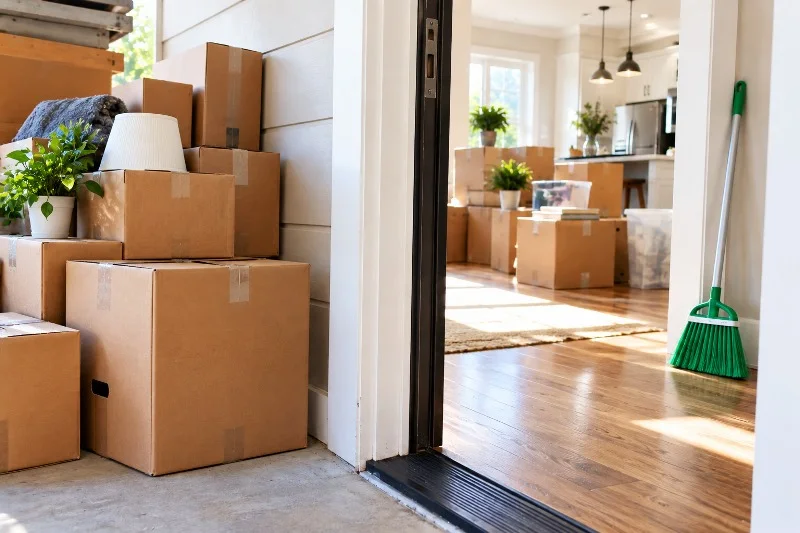
Don't Sweep the House Carelessly When You First Arrive
This is another belief I grew up hearing, although it has stronger connections to Eastern traditions.
Some families avoid sweeping immediately after entering a new home, especially during a time considered important for the move.
The belief is that you could symbolically sweep away the good fortune that has just entered.
Relatives and friends may arrive with gifts, congratulations, and wishes for happiness and prosperity. Traditionally, some people prefer to let those blessings "stay" rather than immediately sweeping the house.
Obviously, the floor will eventually need cleaning.
What matters here is the symbolism attached to that first moment, not avoiding housework forever.
Keep Hoes and Shovels Out of the Main Living Space
Hoes, shovels, and similar tools appear in some old beliefs surrounding the home.
Because they are used to dig into the earth, certain traditions associate them with disturbed soil and heavy outdoor labor. Sharp metal tools can also symbolize conflict or disruption.
For that reason, some people avoid carrying these tools through the main rooms when first moving in. They go directly to the garage, shed, yard, or wherever they will normally be stored.
There is a practical side to this tradition too. A muddy shovel probably doesn't belong in the living room.
It's a good example of how practical habits and folk beliefs can become intertwined over time.
Enter and Leave Through the Front Door the First Time
Most homes have several entrances: the front door, back door, side door, or perhaps a door from the garage.
According to one old moving tradition, however, the first entrance is different.
Each member of the household should enter the new home through the front door for the first time and leave through that same front door.
So if you enter through the front door, you shouldn't walk through the house and make your first exit through the garage or back door.
Each family member completes that first entrance and exit using the front door.
Once everyone has done it, the tradition is complete. After that, the family can use any entrance normally.
The front door traditionally represents the formal entrance to the household. In some versions of the belief, entering one way and leaving another during that first visit could disturb the good fortune of the new home.
I find this one interesting because it turns an ordinary action—walking through a doorway—into a small family ritual.

Don't Bring "Old Troubles" With You
This is one tradition that makes sense to me beyond superstition.
Moving forces us to go through things we've accumulated over the years.
Some are worth keeping because they hold good memories. Others are broken, useless, or connected to a part of life we'd rather leave behind.
Folk traditions sometimes warn against bringing those "old troubles" into a new home. Broken or badly damaged household items may also be avoided because they can symbolize difficulty, stagnation, or unfinished problems.
I don't take that to mean everything old should be thrown away.
An old photograph, a table passed down from your parents, or a book you've owned for twenty years can be far more meaningful than something new.
Old isn't the same as troubled.
But moving does give us a chance to look at something and ask:
Do I really need to carry this into my next home?
Sometimes leaving something behind is simply part of moving forward.
Avoid Moving on Friday or the 13th
The number 13 already has a well-known reputation in American culture.
Some hotels and high-rise buildings even avoid labeling a floor as the 13th floor, and Friday the 13th has become almost synonymous with bad luck.
Similar ideas appear in moving traditions.
In some older beliefs, Friday was considered an unlucky day to begin an important journey or undertaking. For someone who also considers 13 unlucky, moving on that date may feel like an unnecessary risk.
Of course, plenty of people move on Fridays and on the 13th without thinking twice about it.
But someone who grew up with the superstition may simply choose another date rather than begin life in the new house feeling uncomfortable about the timing.
Don't Give Knives or Scissors as a Housewarming Gift
This one is worth mentioning even if you're not the person moving.
If you're visiting friends or relatives in their new home, think twice before bringing knives or scissors as a housewarming gift.
In folk tradition, sharp objects can symbolize cutting a relationship. A knife or pair of scissors may therefore be associated with separation, conflict, or a friendship being severed.
Some versions of the tradition have a simple workaround: the recipient gives the giver a small coin, making the knife technically a purchase rather than a gift.
Personally, I'd just choose something else.
There are plenty of housewarming gifts associated with good wishes, prosperity, and a happy home, which is another folk tradition worth exploring on its own.

Are These Traditions Just Superstition?
That's probably the obvious question.
For me, the more interesting question is why these customs have survived.
Moving is exciting, but it can also make people uneasy. You're leaving a familiar place and beginning life somewhere you haven't lived before.
If you grew up hearing that certain things should be done—or avoided—when moving, ignoring them can leave a small thought in the back of your mind:
Maybe I should have done it.
That's where I think these traditions can matter.
Not necessarily because an old broom changes what will happen in the house, but because leaving it behind may make someone feel that old problems are staying behind too.
The same is true of entering through the front door or choosing not to bring a broken object connected with an unhappy memory.
These are small actions, but they can make the move feel complete.
I don't think anyone should become afraid of breaking one of these traditions. Forgetting a custom shouldn't mean that something bad is waiting for your family.
But if a simple tradition makes someone feel more comfortable walking into a new home, I can understand why they choose to keep it.
A New Home, a New Chapter
Some old customs deserve to be questioned, especially when they frighten people, cause harm, or pressure someone into spending money because they're afraid of what might happen otherwise.
But many moving traditions are much simpler than that.
Leave an old broom behind. Use the front door the first time. Don't carry things you no longer want into the next house.
Behind these customs is something very familiar: we want life in the new home to go well.
Looking back, I understand my mother better now. As a child, I was thinking about the new house.
My mother was thinking about the family that was going to live inside it.
Perhaps that's why she paid attention to all those little details that made no sense to me at the time.
And perhaps that's also why traditions like these continue to be passed from one generation to the next.