Life today moves very quickly. We have pressure from work, money, relationships, family, and many other things around us. Technology makes life easier in many ways, but it also means that our minds rarely have time to rest.
Still, somewhere in this busy life, many people keep a small place for spirituality.
Sometimes we need that place when we are tired, confused, or simply don't know what to do next. This is also one reason some people come to Tarot reading.
I don't believe that a Tarot card can tell us exactly what will happen tomorrow. If you are standing at a crossroads in your life, the cards cannot choose the road for you. But sometimes they can give you another reason to think about the choice in front of you.
For example, you may draw a card and notice an image that reminds you of something you have been trying not to think about. Or the meaning of a card may make you look again at a decision that you thought was already clear.
It doesn't have to be something mysterious.
Sometimes when our thoughts are confused, we simply need something to start from. Tarot can be that starting point. You look at the cards, think about your question, and then compare what you see with what is happening in your own life.
If you have never tried it before, you can start very simply.
What Do You Need to Start Reading Tarot?
You don't need candles, crystals, a special table, or a room decorated for spiritual practice.To begin, you mainly need a Tarot deck and a quiet place where you can spend a little time without being interrupted.
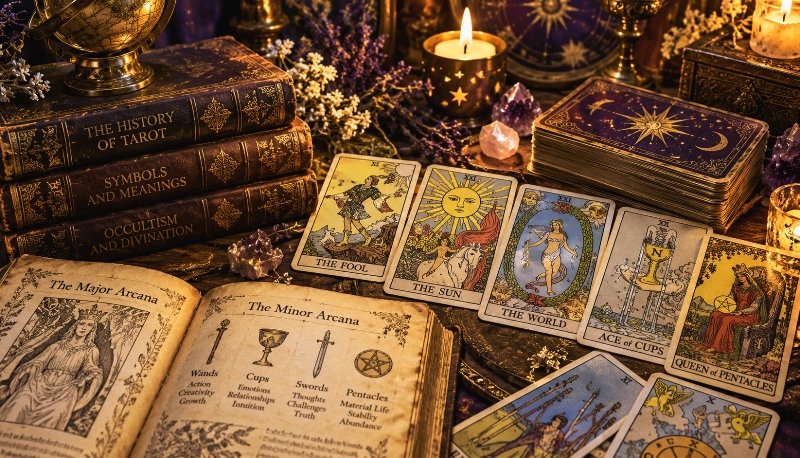
A traditional Tarot deck has 78 cards. They are divided into two main groups:
• Major Arcana: 22 cards.
• Minor Arcana: 56 cards divided into Wands, Cups, Swords, and Pentacles.
When I first picked up my Rider-Waite deck years ago, I also felt overwhelmed by the 78 cards. Each card has traditional meanings and symbols, but don't try to learn all 78 cards before doing your first reading. That can make Tarot much more difficult than it needs to be.
Step 1: Think About What You Really Want to Ask
Before you shuffle the cards, take a moment to think about your question.
Maybe you are having a problem in a relationship. Maybe you want to change your job. Perhaps you have two choices in front of you and don't know which one is better.
Try not to begin with a question that demands a definite prediction.
For example, instead of asking:
"Will I get a new job next month?"
you could ask:
"What should I think about before looking for a new job?"
Instead of:
"Will this person come back to me?"
you could ask:
"What should I understand about this relationship?"
The difference is quite simple.
In the first question, you are asking the cards to predict an event. In the second, you are using the cards to help you think about something that is already happening in your life.
I think this is a better way for a beginner to approach Tarot.
If you'd like more examples, I've written a separate guide on how to ask Tarot cards questions, including questions about relationships, work, and personal decisions.
Step 2: Shuffle the Cards
After you have your question, shuffle the deck.
There isn't one rule that everyone has to follow. Some people shuffle several times. Some stop when they feel ready. Others shuffle and then cut the deck before choosing a card.
You don't need to worry too much about doing it correctly.
While you shuffle, think about the question you have just asked. Try not to change the question again and again in your mind.
When you feel ready, stop and choose your card.
Step 3: Begin With One Card
For your first reading, you don't need a complicated Tarot spread.
Start with one card.
Put the card in front of you and look at it for a moment.
Don't immediately search Google or open the guidebook that came with your deck.
First, look at the picture.
What is happening in it?
Is there a person on the card? What are they doing? Does the picture make you feel comfortable, worried, hopeful, lonely, or something else? Is there one object or detail that catches your attention?
There is no need to find a perfect answer.
Just write down or remember your first impression.
After that, you can read the traditional meaning of the card and compare it with what you noticed.
This is an easy way to slowly become familiar with your deck without trying to memorize everything at once.
Step 4: Try a Three-Card Reading
When you feel comfortable drawing one card, you can try three.
One of the simplest spreads is:
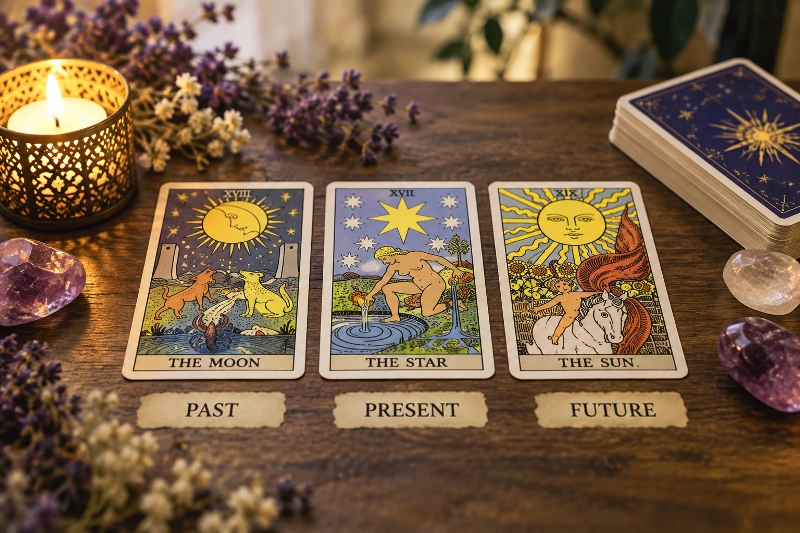
Past → Present → Future
Place three cards from left to right.
The first card represents something from the past that may still affect the situation.
The second card represents where you are now.
The third card looks toward what may come next.
I would not treat the third card as a promise that the future must happen that way.
Life can change. You can change your mind. Other people can make different decisions. An opportunity can appear tomorrow that you don't know about today.
So when you look at the third card, think of it as one possible direction rather than a fixed result.
Step 5: Connect the Cards With Your Real Situation
This is where reading Tarot becomes more interesting.
A card has a traditional meaning, but your question also matters.
The same card appearing in a question about work may make you think differently than when it appears in a question about love.
After learning the basic meaning of the card, come back to your original question.
Ask yourself:
"What does this have to do with the situation I am thinking about?"
Sometimes the connection will seem clear.
Sometimes it won't.
And that is fine.
You don't have to force every card to fit your situation. If a reading doesn't make sense to you, leave it there. You can come back to it later, or simply accept that this reading did not give you anything useful.
Step 6: Don't Worry About Reversed Cards Yet
When you watch experienced Tarot readers, you may notice that some cards appear upside down.
These are called reversed cards, or reversals.
Many readers give a reversed card a different meaning from the same card in its normal position.
As a beginner, I don't think you need to worry about this immediately.
There are already 78 cards to become familiar with. If you try to learn the upright and reversed meaning of every card at the same time, Tarot can quickly turn into a memory exercise instead of something you enjoy doing.
Start with upright cards.
Later, when you know your deck better, you can learn about reversals and decide whether you want to use them.
Don't Try to Memorize Everything
This is probably one of the most useful things to remember when you start.You don't need to memorize the meaning of all 78 cards.
Look at the picture first.
Think about what you see.
Then read the traditional meaning.
After seeing the same cards many times, you will naturally begin to remember them.
A guidebook is there to help you. There is nothing wrong with opening it during a reading.
Keep a Tarot Journal
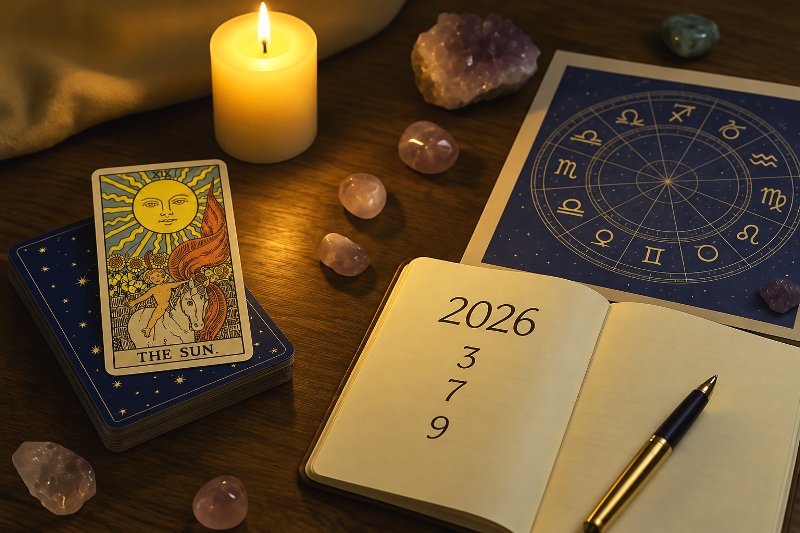
I still keep my first Tarot journal on my desk as a reminder of where I started. One simple way to learn Tarot is to keep a small journal.
Every morning, draw one card. Write down the name of the card and what you think it means before looking at a guide. You can also write a few words about how you feel that morning.
Then continue with your normal day.
At night, look at the card again. Did anything happen during the day that reminded you of it? Maybe there was a small similarity. Maybe the card made more sense after something happened. Or maybe absolutely nothing seemed connected.
Write that down, too. Don't try to change the events of your day in your mind just to make the card look correct.
After doing this for a few weeks, you will have your own record. You can see how you interpreted the cards at the beginning and whether your understanding changed over time. For a beginner, I think this can be more useful than trying to memorize a long list of Tarot keywords.
Learn From Books, but Also Pay Attention to Your Own Feelings
Books and Tarot guides are important because they explain the traditional meaning and symbolism of the cards.Use them.
But don't feel that every reading has to follow one sentence from a book exactly.
Look at the card yourself first.
Sometimes one small detail in the picture will catch your attention because it reminds you of your current situation. That doesn't necessarily mean something supernatural is happening. It may simply be that the image has made you think about something that was already somewhere in your mind.
This is also how I prefer to understand intuition in Tarot.
It doesn't always have to mean a mysterious message coming from somewhere outside us. Sometimes intuition is simply that first feeling that makes us stop and think, “Why did I notice this?”
Tarot in the Digital World
Tarot has been around for centuries. Tarot cards appeared in Europe in the 15th century, originally in connection with card games. Their use for divination developed later.Today, Tarot has moved into a very different world.
You can now find Tarot readings online through websites, apps, video calls, and online communities. Some people still prefer sitting face-to-face with a Tarot reader, while others are comfortable trying a reading through their phone or computer.
The method may change, but the reason people look for Tarot is often very familiar: they have a question, they are worried about something, or they simply want another way to think about what is happening in their life.
A Final Thought About Tarot
Tarot has existed in different forms for centuries, and instead of disappearing, it has continued to change with the way people live. Now it is also part of the digital world.No card can promise that you will find love, become rich, get a new job, or avoid something bad happening. And a Tarot reading should not make important medical, legal, financial, or mental health decisions for you.
So why do people still turn to it?
Sometimes we are confused and simply want something to start from.
Sometimes we already know what is worrying us, but we don't want to face it directly.
And sometimes we just want a little comfort when tomorrow feels uncertain.
Tarot may give us a card, an image, or a meaning to think about. The final decision, however, is still ours.
Perhaps that is enough.
We don't always need something to tell us exactly what the future will be. Sometimes we only need a small reason to think again, to feel a little calmer, and to believe that there may still be something good waiting for us somewhere ahead.
Curious about what an online Tarot reading is like?