On weekends, I usually spend time reading books or visiting relatives. During one of those visits, I happened to meet my niece. Her eyes were still red, and I could tell she had been crying.
I asked her what had happened. She told me that she and her boyfriend had broken up about a month earlier, and she was still feeling very sad.
She had tried reading Tarot cards herself and had also asked a friend who knew how to read them. Both times, she wanted to know the same thing:
“Will my boyfriend come back?”
I almost smiled, but I held it back because I didn't want to hurt her feelings.
Instead, I told her that if she wanted to understand what Tarot was telling her, she should first learn how to ask questions and consider the situation she was actually facing.
That conversation made me think about something I had encountered while learning about Tarot. We often pay so much attention to the cards we draw that we overlook the question we asked in the first place.

Why Does Asking the Right Tarot Question Matter?
When people turn to Tarot, they usually have something on their minds. It might be a relationship, a job opportunity, a financial concern, or a decision they are afraid to make.
Naturally, they want an answer.
But I have come to think that a Tarot question should do more than express what we hope will happen.
Consider two questions:
• Will my relationship work out?
• What should I understand about the difficulties in my relationship?
The first asks for an outcome. The second invites us to look at the situation more closely.
Neither question is necessarily wrong. Some Tarot readers use yes-or-no readings, while others prefer open-ended questions.
Personally, I find open-ended questions more interesting because they give the reader more room to explore the cards in relation to the circumstances.
A question should also be specific enough to interpret. Asking "What will happen to my life?" covers almost everything. Asking "What should I consider before changing careers?" gives the reading a clearer direction.
How I Approach Tarot Questions
I see Tarot as part of the spiritual world, rather than simply a collection of illustrated cards.
My personal belief is that our emotional state and inner energy may have some connection with the cards we are drawn to. When someone is anxious, hopeful, heartbroken, or excited, those feelings may influence how they approach a reading.
I am also interested in how Tarot meanings have developed through tradition, observation, and the experience of readers over time.
For me, understanding a reading involves more than memorizing what each card represents. It involves considering the question, the person's circumstances, and the relationship between the cards.
This is the perspective I bring to the examples below.

Tarot Questions to Ask About Love and Relationships
Love is probably one of the most emotional reasons people seek a Tarot reading.
When a relationship is going well, we may wonder about its future. When it ends, we may desperately want to know whether the other person will return.
I understand why my niece asked her question. But I would encourage someone in her situation to explore several possibilities rather than focus entirely on one expected answer.
If you are in a relationship:
• What should I understand about our relationship right now?
• What challenges may be affecting our connection?
• How can I communicate better with my partner?
• What should we pay more attention to in our relationship?
If you have recently broken up:
• What can I learn from this relationship?
• What should I understand before trying to reconnect?
• What feelings may be preventing me from moving forward?
• What possibilities should I consider for my emotional future?
If you are looking for love:
• What should I understand about my expectations of love?
• What might be holding me back from a new relationship?
• What qualities matter most to me in a partner?
I prefer these questions because they allow the reading to explore more than a simple prediction.
They also remind us that relationships involve two people, and the choices of one person cannot be determined entirely by the wishes of another.

Tarot Questions to Ask About Career and Work
Career questions are different from love questions, but they often come from the same feeling: uncertainty.
Someone may be unhappy at work, afraid of changing jobs, or unsure whether a new opportunity is worth pursuing.
Instead of asking only, "Will I get the job?" I would consider questions such as:
• What should I understand about my current career situation?
• What strengths could help me move forward?
• What challenges should I prepare for before changing jobs?
• What should I consider before accepting a new position?
• What might be holding me back professionally?
• Where should I focus my efforts in the coming months?
For financial matters, I would be especially careful about expecting Tarot to provide an exact outcome.
A reading may offer a spiritual perspective, but practical decisions still require information about income, expenses, opportunities, and personal responsibilities.

Tarot Questions for Life and Personal Growth
Not every Tarot question needs to involve another person or a major event.
Sometimes we simply feel uncertain about ourselves.
We may be wondering why we keep making the same mistakes, why a particular situation makes us uncomfortable, or whether it is time to begin something new.
Some questions worth exploring include:
• What should I pay more attention to in my life right now?
• What can I learn from a recent difficult experience?
• What fears may be influencing my decisions?
• What should I consider before making an important change?
• What part of my life needs more care and attention?
• What possibilities have I been overlooking?
These questions interest me because they connect spiritual interpretation with everyday experience.
Even when a reading does not provide a definite answer, it may encourage us to look at a familiar situation from another perspective.
How the Cards Connect: A Three-Card Example
This is where I believe Tarot interpretation becomes particularly interesting.
A beginner may learn the meaning of each card separately. But in a spread, the cards are not necessarily interpreted as isolated messages.
Their positions and relationships matter.
Imagine someone asking:
"What should I understand before trying to reconnect with my former partner?"
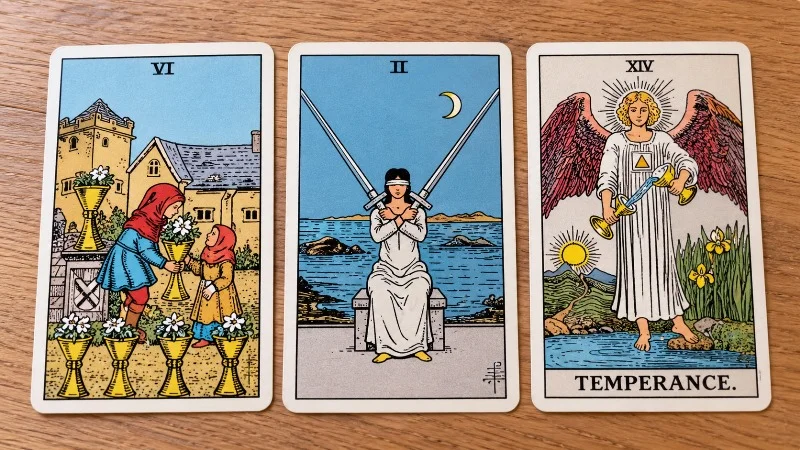
For this example, we will use three positions: Situation, Challenge, and Advice.
Card 1 — Situation: Six of Cups
The Six of Cups is often associated with memories, nostalgia, and connections to the past.
In this position, it might suggest that the person still feels emotionally attached to an earlier relationship or remembers its happier moments.
Card 2 — Challenge: Two of Swords
The Two of Swords is commonly associated with indecision, conflicting thoughts, or difficulty facing a choice.
Here, it might suggest that the person has not fully considered the reasons for the breakup or is struggling to decide what to do next.
Card 3 — Advice: Temperance
Temperance is traditionally connected with balance, patience, and moderation.
In the advice position, it could encourage a calmer approach rather than an immediate attempt to restore the relationship.
Reading the three cards together
If we interpret each card separately, we have memories, indecision, and patience.
But together, they suggest something more connected.
The person may be holding on to memories of a relationship while struggling to face its present reality. Before attempting reconciliation, they may need time to understand what happened and what both people actually want.
Notice that this interpretation does not establish whether the former partner will return.
It explores the emotional situation surrounding the question.
This is an illustrative combination, not a real reading performed for my niece.
To me, this is one of the most important parts of learning Tarot: understanding how individual meanings develop into a connected interpretation.
Different readers may see additional meanings depending on the deck, the surrounding cards, and their own experience.
If you are beginning to learn, my articles on how Tarot reading works and the Past, Present, Future Tarot spread explain some of these foundations in more detail.
Should You Keep Asking the Same Tarot Question?
There is another situation I think beginners should consider.
Imagine asking whether a former partner will return, drawing three cards, and feeling disappointed by the interpretation.
You shuffle again and ask the same question.
Then you try another spread, hoping for a different answer.
I can understand why someone might do this, particularly when emotions are involved.
But repeatedly asking the same question without anything changing in the situation may create more confusion than understanding.
I would rather take time to consider the first reading, look at the circumstances, and return to the cards later if there is a genuinely new question.
The same applies to questions demanding exact dates or guaranteed outcomes.
"When will I become rich?" may express a strong wish, but "What should I consider before making an important financial decision?" gives the reader a clearer situation to explore.
Final Thoughts
When I think about my niece, I remember how much she wanted her boyfriend to come back.
I couldn't give her the answer she hoped for, and I don't think a single Tarot card should be expected to settle such a personal question.
But I do believe there is something worth exploring in the connection between our emotions, the questions we ask, and the meanings we find in a Tarot reading.
For me, Tarot remains a spiritual subject that requires patience, observation, and experience.
Sometimes the first question we ask is simply the one we most desperately want answered.
A better question may help us understand why we are asking it at all.