When you first start learning and practicing Tarot, you may feel the same way I did. There are 78 cards with many different meanings, divided between the Major Arcana and Minor Arcana, and at first I really didn't know where to begin. But one thing I was curious about was what Tarot could tell us about the past, the present, and the future.
That was why I became interested in the Past, Present, Future spread. It felt suitable for me as a beginner because I could practice with only three cards instead of trying to understand too many cards at once. I also found that sitting quietly with a Tarot reading sometimes helped me take my mind away from work and the pressure of everyday life for a while.
So how do we read the past, present, and future with three cards? I'll share the basic way I've been learning it. Reading Tarot takes experience, and I certainly don't understand every meaning yet. Knowing what each card means is important, but understanding the connection between the three cards you draw is also a big part of the reading.
What Is a Past, Present, Future Tarot Spread?
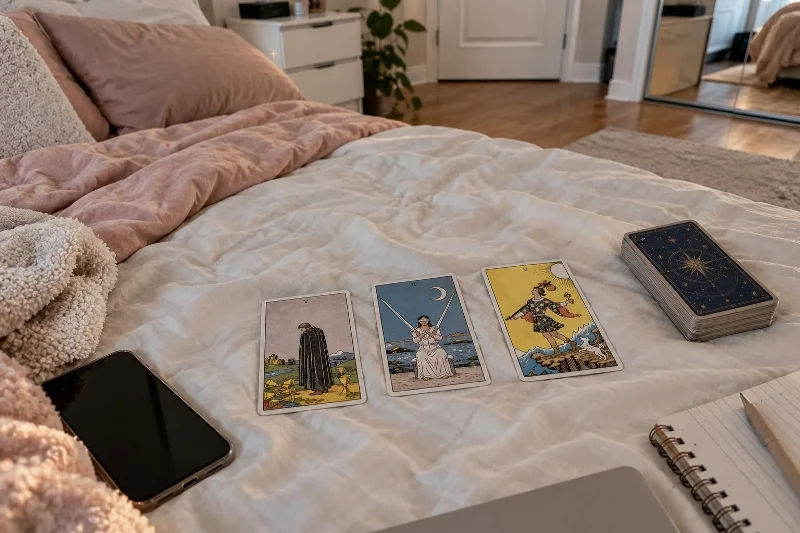
A Past, Present, Future Tarot spread uses three cards: Card 1 represents the Past, Card 2 represents the Present, and Card 3 represents the Future.
The important part is the connection between them. Something that happened in the past may be affecting what is happening in your life now, and what is happening now may have an effect on what comes later.
Love is an easy example. A relationship from the past may have ended badly and left you afraid of being hurt again. Even though that relationship is over, the experience can still affect the way you think and behave in a new relationship. If those feelings continue, they may also affect where that new relationship goes in the future.
That's the simple way I understand this spread: look at what happened before, what is happening now, and what may happen next, then try to find the connection between them.
Card 1: The Past
The first card represents something that has already happened. It doesn't have to be something from many years ago. It could be an old relationship, a decision you made, an argument, a missed opportunity, or something more recent.
For example, suppose I'm asking about love and I draw the Five of Cups. From what I've learned so far, I understand this card as being connected with disappointment and loss. So I might think about a previous relationship that ended badly and whether some of those feelings are still with me.
I'm sure someone who has studied Tarot much longer could find more meaning in this card. Maybe I haven't read and practiced enough yet, so this is about as much as I would understand from it at this point. But it still gives me somewhere to begin: something happened in the past, and I want to know whether it is still affecting me today.
Card 2: The Present
The second card represents what is happening now. Suppose I draw the Two of Swords. I understand this card as being connected with hesitation, uncertainty, or having difficulty making a decision.
Now I can connect it with the first card. Maybe I was hurt in an old relationship, and today I have met someone new but I'm afraid to trust that person completely. Perhaps I'm hesitating because I don't want to make the same mistake again.
Again, I may not understand every meaning of the Two of Swords. I'm still learning. But I can at least see one possible connection between the two cards: something that happened before may be affecting the way I'm thinking and making decisions today.
Card 3: The Future
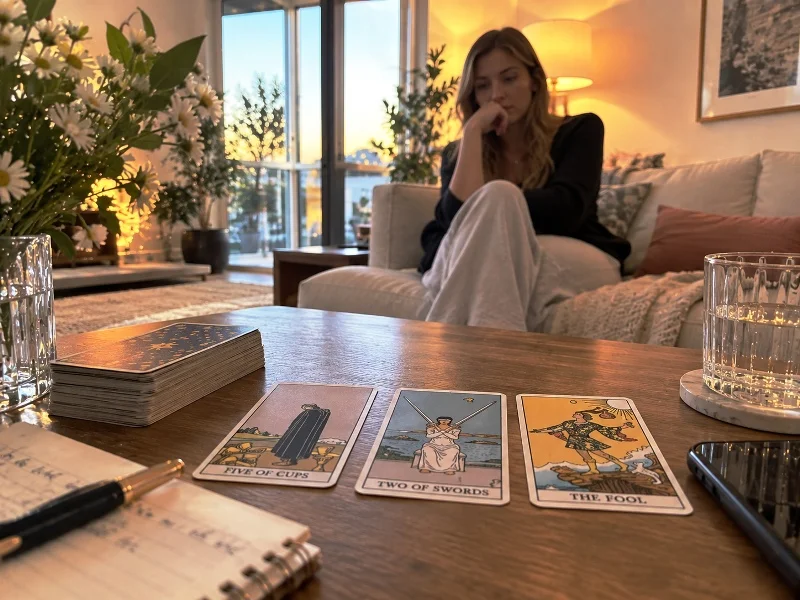
The Future card is probably the one many of us are most curious about. Let's say the third card is The Fool. One meaning I've learned for The Fool is a new beginning or moving into a new experience.
I wouldn't immediately read that as “I'm definitely going to meet someone new.” Instead, I would go back to the first two cards. The Five of Cups showed disappointment in the past, the Two of Swords showed hesitation in the present, and now The Fool suggests the possibility of something new.
Perhaps this means that if I can move beyond some of the fear created by the past, I may be ready for a new beginning. That could be a new relationship, leaving an old relationship behind, or simply changing the way I approach love. I don't think I know enough about Tarot to say exactly what will happen. At my current level, I would understand the three cards in that general direction.
How to Do a Simple 3-Card Tarot Reading
This can be a problem when we first start practicing. We draw three cards, don't really understand them, and then draw another three. The second reading is different from the first, so we start wondering which one is right. If we keep drawing again and again, we may end up more confused than when we started.
I think it's important to remember that we're practicing how to read Tarot. When reading for yourself, find somewhere quiet, think sincerely about the question you want to ask, and try to keep your mind on it. Shuffle the deck, draw three cards once, and place them in order: Past → Present → Future.
Then work with those three cards. Read their meanings, think about your own situation, and try to understand how they connect. You don't have to understand everything on the first try.

How Do the Three Cards Work Together?
Every Tarot card has its own meaning, and I made a mistake with this when I first started. I would read one card, think about its meaning, then move to the next card and do the same thing. After reading all three separately, I sometimes still didn't understand what the reading was trying to tell me.
I think this can happen quite easily when we're beginners. We need to connect the meanings of the three cards instead of stopping at each one.
Using the same example, the Five of Cups may show disappointment from a past relationship, the Two of Swords may show hesitation today, and The Fool may suggest a new beginning. When I connect them, I might understand that an old disappointment is one reason I'm afraid to make a decision now, and dealing with that fear may help me move toward something new.
That's much easier for me to understand than three separate card meanings. So when I practice, I try not only to ask “What does this card mean?” but also “How does its meaning connect with the other two cards?”
Questions You Can Ask With This Spread
You can use normal questions from everyday life, such as:
• Where is my relationship heading?
• What should I understand about my current work situation?
• What has brought me to this point?
• What should I know about a decision I'm facing?
I think the Past, Present, Future spread works better with open questions. For example, instead of asking “Will I become rich next month?”, I could ask “What should I understand about my current financial situation and where it may be heading?”
The second question gives me more room to look at what happened before, what I'm doing now, and how my current choices may affect what comes next.
Before drawing your three cards, it helps to have a clear question in mind. I've collected more Tarot question examples for love, career, and life if you're not sure where to begin.
Can You Do a Past, Present, Future Reading Online?

With 78 Tarot cards and so many possible meanings, it's easy to feel confused when you're starting out, especially when you also have to understand how several cards connect. You want to learn, but suddenly there seems to be a lot to remember.
Sometimes seeing how another person interprets a reading can be one of the quicker ways to learn. Not everyone has the time to meet an experienced Tarot reader in person, so an online Tarot reading can be another option.
You can look at the three cards, read how they are interpreted, and compare that interpretation with your own. It may also give you a little time away from the pressures of everyday life, but I think the more useful part for a beginner is learning from another interpretation and then using that experience when practicing Tarot again.
Try a 3-Card Tarot Reading →
Final Thoughts
Starting a new job can be difficult, and learning a new sport can be difficult too. Tarot is the same. There are 78 cards with many different meanings, and even when we draw only three cards for the Past, Present, and Future, those three cards can still have different meanings depending on how they appear together. Especially as beginners, we probably can't understand everything in them.
So I think we can start with what we understand. Look at the Past card and think about what happened. Look at the Present card and think about what is happening now. Then look at the Future card and think about what may happen next. After that, connect the three and think about what they mean for your situation.
We may not know exactly what will happen tomorrow or later in the future. But after looking at what happened in the past and what is happening today, we can think about something that matters right now: What should I do?
Maybe there is something we should change, something we should continue doing, or something from the past we need to deal with. If a three-card Tarot reading helps us think about what we can do today so that tomorrow, the next day, and the future can be better, then for me, that is already a useful way to practice Tarot.